
Even if you’re a brilliant, up-to-date physician, your patients won’t benefit unless you can get them in the door to your practice. Patients who are at the end of your appointment queue are faced with three options: wait for their time with you and risk their condition Continue reading
Urine drug screening
Urine drug screens (UDS) are a valuable tool in our management of patients on chronic opioid therapy. However, the results can be misleading and clinical judgment is needed in interpreting results. Continue reading
Obesity and hunger, all in the same country!
According to the USDA, in 2013, 14.3% of U.S. households were food insecure, meaning a lack of access at all times to enough food for an active, healthy life for all household members. This was divided into those with low food security — 8.7% — and and those with Continue reading
Longevity calculator
The Brits have come up with an interesting on-line calculator which enables people between ages 40 and 70 to estimate their risk of dying within the coming five years. The calculator relies on a massive database looking at 500,000 people living in Britain to assess what factors tend to foretell or forestall mortality. For men, the strongest Continue reading
Can older smokers be motivated to stop?
Older smokers can be a tough group. After decades of tobacco use, it can take a lot to get them to even talk about considering the remote possibility of thinking about stopping their habit. Smoking got them through some hard times, pardner. Their grandfather Continue reading
Sunscreen season
Now that the summer solstice is in the rearview mirror, it is time to start reminding patients about the importance of and appropriate use of sunscreen. People of all ethnicities and skin colorations can benefit from sunscreen, though lighter skinned Continue reading
Get ready for powdered alcohol
Call me naïve, but I was surprised a few days ago to learn that powdered alcohol will start being sold this summer. I guess I missed that memo. This new product will initially come in five flavors: rum, vodka, cosmo, margarita, and lemon drop Just mix the Continue reading
Does ADHD in adults start in childhood?
I will open this post with the bottom line. No one has the definitive answer to this question. Yet. But interesting information can be found in a study published last month in The American Journal of Psychiatry. This study suggests that ADHD in adults does Continue reading
Are you scratching your head about what to do about lice?
You are all familiar with a scourge that has plagued mankind for centuries without relief in sight. It has attacked humans of all ages but predominantly targets children. It is currently the source of many missed school days as well as parental and school Continue reading
Radiation risk
The Biologic Effects of Ionizing Radiation report was initially requested by the U.S. Environmental Protection Agency in 1996. Since then, there have been several revisions of the BEIR report, the last being the BEIR VII Report in 2005. BEIR VII was different in that it also looked at the effects of low dose (<100 MSv) radiation on humans.
BEIR VII estimated a 1:1000 risk for cancer from one 10 mSv exposure to radiation. This is the radiation exposure from one abdominal, pelvic, or chest CT. These are imaging studies we order very commonly in our practices. In fact, there were over 70 million CT scans ordered in the United States in 2007 with projections that this may cause 29,000 future cancers.
No one really knows whether there is significant risk from one CT scan. These estimates of risk are based on an analysis of large populations over time using a linear non-threshold extrapolation. However, even if the risk from one scan is small, it is not insignificant and people are exposed to so many studies over a lifetime.
Background exposure to natural radiation in the United States is about 3 mSv per year (mostly from radon). In 1980, the average radiation dose per person in the U.S. from all sources was 3.6 mSv per year. However, by 2007, the average dose in the U.S. had nearly doubled to 6.2 mSv per year. CT scans have become the biggest source of radiation exposure to humans after background radiation.
The risk of cancer varies by age and gender. The risk of cancer is much higher for those under 20 years of age and for females. We need to be especially careful in imaging children. There are over 7 million CT scans performed annually on children in the U.S. Pediatric radiologists practice ALARA (as low as reasonably achievable) in imaging children, but nothing is better than judicious ordering to protect our children.
| Age | 5 | 10 | 20 | 30 | 40 | 50 | 60 |
| Male | 1:557 | 1:692 | 1:1024 | 1:1458 | 1:1543 | 1:1692 | 1:2045 |
| Female | 1:296 | 1:383 | 1:608 | 1:939 | 1:1129 | 1:1351 | 1:1706 |
Estimated life-time risk of cancer, BEIR VII Phase 2, 2006
The radiation dose our patients receive varies by the type of study. Although plain films do not expose our patients to large doses of radiation, a CT of the abdomen or a barium enema is equivalent to about 750 chest x-rays, or more than 3 years of background radiation.
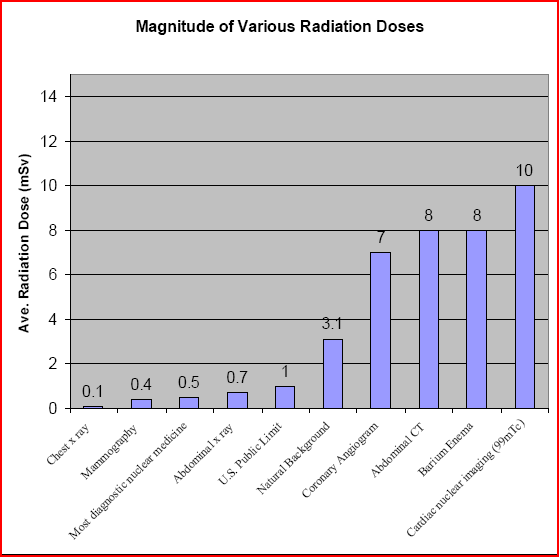
So yes, we need to be careful in ordering CT scans or other high-dose radiation imaging for our patients. This is our problem since the best predictor of radiation exposure in a population is the number of physicians in practice in that community.
Jim Cotter, MD MPH