
In October, Dr. Karen Stephen, the Director of Behavioral Health at Partnership Health Plan, attended the CIBHS 2015 California Behavioral Health Policy Forum. She returned with some reflections Continue reading
Category Archives: Uncategorized
Partners in Palliative Care – PHC’s Pilot Program
Many of you are aware of hospice, either as inpatient or free standing service, which is a program providing a comprehensive set of services. These services include those that offer comfort and assistance to terminally ill patients with less than 6 months to live. Continue reading
Memories Fade
Memories fade. Like looking through a fogged mirror…or scope
How quickly fades from our minds the delightful memories of our adventures in dreamy Colonoscopyland. Continue reading
Housing as Health Care
If a pharmaceutical representative walked into your office with a new drug that would reduce mortality by 15% and saved society $20,000 per year, would you start to use it in your practice? Continue reading
Radiation risk
The Biologic Effects of Ionizing Radiation report was initially requested by the U.S. Environmental Protection Agency in 1996. Since then, there have been several revisions of the BEIR report, the last being the BEIR VII Report in 2005. BEIR VII was different in that it also looked at the effects of low dose (<100 MSv) radiation on humans.
BEIR VII estimated a 1:1000 risk for cancer from one 10 mSv exposure to radiation. This is the radiation exposure from one abdominal, pelvic, or chest CT. These are imaging studies we order very commonly in our practices. In fact, there were over 70 million CT scans ordered in the United States in 2007 with projections that this may cause 29,000 future cancers.
No one really knows whether there is significant risk from one CT scan. These estimates of risk are based on an analysis of large populations over time using a linear non-threshold extrapolation. However, even if the risk from one scan is small, it is not insignificant and people are exposed to so many studies over a lifetime.
Background exposure to natural radiation in the United States is about 3 mSv per year (mostly from radon). In 1980, the average radiation dose per person in the U.S. from all sources was 3.6 mSv per year. However, by 2007, the average dose in the U.S. had nearly doubled to 6.2 mSv per year. CT scans have become the biggest source of radiation exposure to humans after background radiation.
The risk of cancer varies by age and gender. The risk of cancer is much higher for those under 20 years of age and for females. We need to be especially careful in imaging children. There are over 7 million CT scans performed annually on children in the U.S. Pediatric radiologists practice ALARA (as low as reasonably achievable) in imaging children, but nothing is better than judicious ordering to protect our children.
| Age | 5 | 10 | 20 | 30 | 40 | 50 | 60 |
| Male | 1:557 | 1:692 | 1:1024 | 1:1458 | 1:1543 | 1:1692 | 1:2045 |
| Female | 1:296 | 1:383 | 1:608 | 1:939 | 1:1129 | 1:1351 | 1:1706 |
Estimated life-time risk of cancer, BEIR VII Phase 2, 2006
The radiation dose our patients receive varies by the type of study. Although plain films do not expose our patients to large doses of radiation, a CT of the abdomen or a barium enema is equivalent to about 750 chest x-rays, or more than 3 years of background radiation.
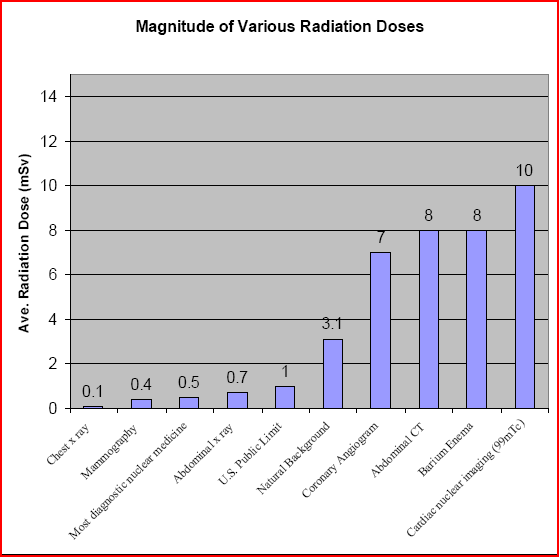
So yes, we need to be careful in ordering CT scans or other high-dose radiation imaging for our patients. This is our problem since the best predictor of radiation exposure in a population is the number of physicians in practice in that community.
Jim Cotter, MD MPH
Bye-bye bimanual
When I was the medical director of the Sonoma County Public Health outpatient clinics, which included the Family Planning and STD clinics, I would commonly discuss the lack of need for a bimanual exam of the, typically, young women who used our services if they Continue reading
Experts are growing hoarse warning us about antibiotic prescribing
If you are reading this post, you have repeatedly heard the cautions about avoiding overuse and inappropriate prescribing of antibiotics. Well, the national experts who continue warning us on this topic feel they are speaking into deaf ears. Continue reading
“I don’t want to hold your hand.” – C.S.Lewis. “I want to hold your hand.” – The Beatles
A recent survey of multiple large, national databases in the US has reported that Clostridium difficile (C.diff) colitis is now the 9th leading cause of gastrointestinal and liver related deaths. Way out of line with my own perception of GI-related mortality, Continue reading
For whom the bell tolls – steroids or antivirals for Bell palsy?
Sir Charles Bell first described the anatomy and function of the facial nerve in the 1800s. No wonder the eponymous Bell palsy bears his name (apparently we are no longer to refer to it as Bell’s palsy). The term Bell palsy is not synonymous with Continue reading
Knee MRI – are we getting TMI (Too Much Information)?
A recent BMJ study is an eye-opener about problems interpreting knee MRI’s in older adults. The bottom-line? A picture may not be worth a thousand words.
Let’s look briefly at Continue reading